
[To keep up with our latest research and updates, follow us on Twitter @RJMetrics]
Since my guest post on TechCrunch last fall, I’ve received frequent requests to update and expand upon my Twitter data analysis. As the Twitter API continues to improve, our ability to profile the company from the outside-looking-in becomes even stronger. I recently conducted an updated round of analysis and will be posting my findings in a series of posts here at The Metric System in the coming weeks.
Updating this analysis in RJMetrics was just a matter of a few clicks, and we could easily highlight the most interesting tidbits of new information. If you’d like that level of control of your own business’s data, you should try out our demo to learn more.
Today, I’m starting with an update of the basics: users and engagement.
Results Summary
We analyzed data through the end of 2009. Where the data overlapped with our previous analysis (which ran through August 2009), the findings were highly consistent. However, the updated data revealed the following noteworthy trends:
- Twitter ended 2009 with just over 75 million user accounts.
- The monthly rate of new user accounts peaked in July 2009 and is currently around 6.2 million new accounts per month (or 2-3 per second). This is about 20% below July’s peak rate.
- A large percentage of Twitter accounts are inactive, with about 25% of accounts having no followers and about 40% of accounts having never sent a single Tweet.
- About 80% of all Twitter users have tweeted fewer than ten times.
- Only about 17% of registered Twitter accounts sent a Tweet in December 2009, an all-time-low.
- Despite these facts, Twitter users are becoming more engaged over time when we control for sample age.
How We Did It (Again)
We are not associated with Twitter in any way and have no direct access to their backend data. However, we do have access to their API. This allowed us to take advantage of a few unique characteristics of the Twitter data set:
- A Twitter user’s activity data (tweets, followers, etc) is all public by default
- Twitter’s API allowed us to automatically download up to 20,000 data points per hour
- Twitter uses auto-incrementing ID numbers (1,2,3,4…) for both users and tweets, and the percentage of unused numbers can easily be detected via the API
- The central limit theorem tells us, among other things, that a large enough random subset of a large data set will behave like its parent set with a high degree of statistical confidence
We downloaded just under 2 million tweets from about 50,000 users to conduct this analysis. As before, one restriction we should note is that we were only able to download the most recent 3,200 tweets for each user. This means we may be missing part of the data for “power users” who have sent over 3,200 tweets (they represent less than a tenth of a percent of the Twitter population).
Number of Twitter Users
By leveraging the auto-incrementing ID numbers used by Twitter and our ability to predict the ratio of used to unused IDs, we identified the following data on new Twitter users by month:
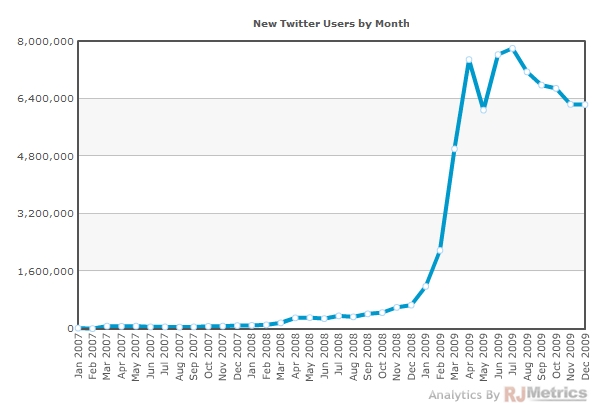
As you can see, the number of new users per month is currently at about 6.2 million. This is an enormous number, but it is about 20% lower than the July 2009 peak of 7.8 million. In fact, the past 6 months have shown steady decline in the number of new account registrations.
The chart below is is a cumulative version of the chart above. It shows us the remarkable growth experienced by Twitter in 2009:
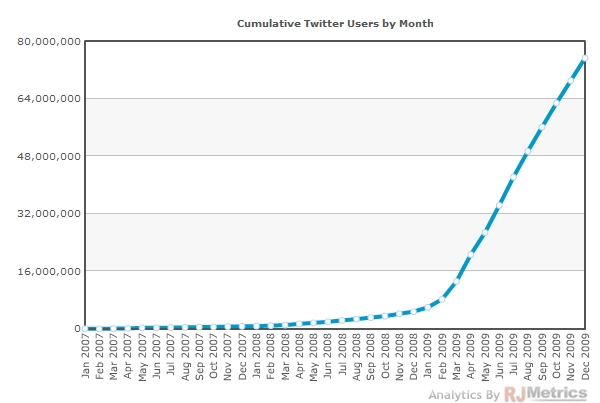
Twitter’s hockey stick continues to blaze a trail upward and to the right. As we identified above, the recent data points are showing a linear, rather than exponential, growth trajectory. Twitter ended 2009 with just over 75 million active user accounts.
Average Number of Followers
This is the area where we saw the most change from the August data. According to the data, the average Twitter user has 27 followers, down from 42 followers in August 2009. The distribution of users by follower count is shown below:
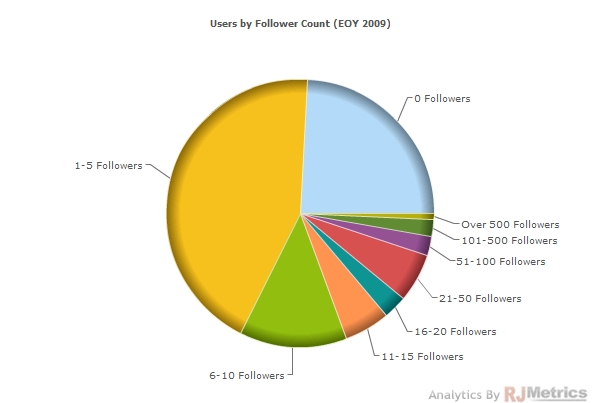
Back in August, the “0 Followers” piece of the pie was about 20%. Now it’s closer to 25%. A likely reason for the drop in average number of followers is Twitter’s rapid growth rate. A third of Twitter’s user base has joined up in the past 4 months, and we know (as shown in the chart below) that users acquire more followers the longer they are on the system.
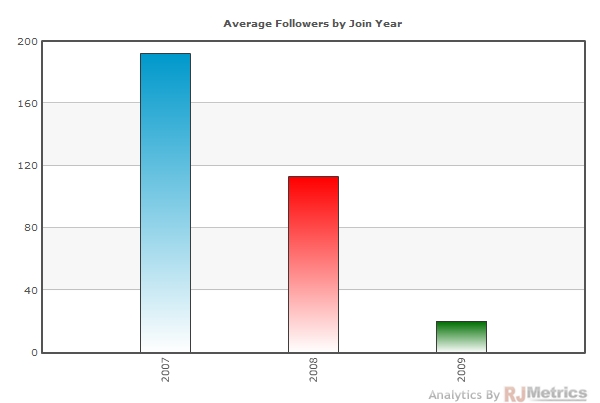
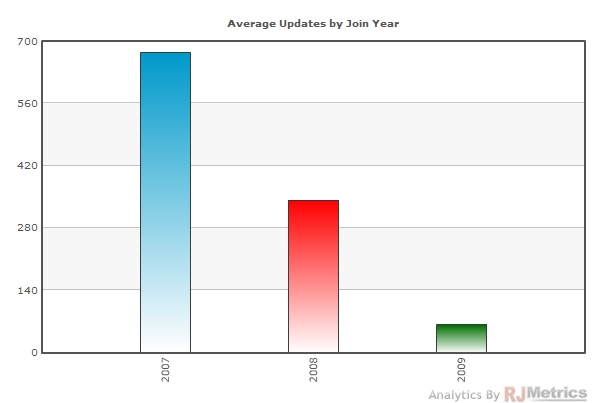
As long as Twitter is acquiring new users at such a rapid rate compared to its average historical month, the average number of followers will be pushed downward by the “youngness” of the average user and the average number of followers will continue to drop. However, it is impossible to tell from this chart if the small stature of the 2009 bar is only due to user age or if additional variables (such as a change in user engagement levels) are at play.
To find out the truth, we will incorporate user engagement data into our analysis. A reliable way of quantifying user engagement is by studying Twitter’s most measurable user activity: tweeting.
Number of Tweets
Below we show a distribution of Twitter users by the number of status updates (“tweets”) they have ever sent.
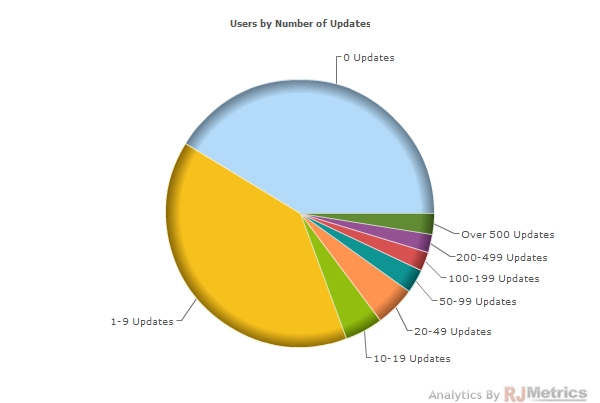
As before, the “youngness” of the Twitter user population is surely skewing this data toward lower numbers, but even still the numbers we see are quite astounding: about 80% of all Twitter users have tweeted fewer than ten times. This is up from the 75% we detected when analyzing data through August 2009.
As you might expect, the average number of Tweets increases over a user’s lifetime. This is demonstrated below, where we show the average number of Tweets sent by the user’s join year.
Active Tweeters
Twitter has a massive number of user accounts, but we now know that a large percentage of them aren’t active. The chart below, which shows the percentage of registered accounts that sent at least one tweet each month, helps us reconcile these facts and quantify how engagement may be changing over time.
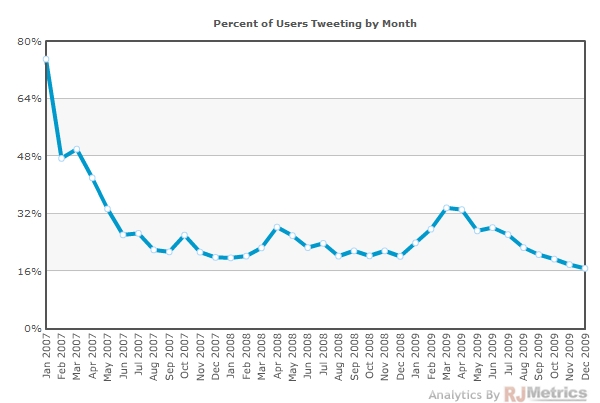
The percentage averages around 20% of accounts, although it was above 50% in Twitter’s earliest days. One concerning trend, however, is that this metric has consistently declined over the past six months, and is currently at an all-time low of 17%.
Note that, due to Twitter’s rapid user growth, the absolute number of users who tweeted that same month is probably one of the company’s highest ever, despite this all-time low percentage.
Cohort Analysis
We can use a cohort analysis to look at user behavior and loyalty over time. Below, we show five “cohorts,” each representing a specific week in Twitter’s history. A cohort consists of every user who made their first tweet in the specified week. The lines in this chart show what percentage of those users come back and tweet again in each subsequent week.
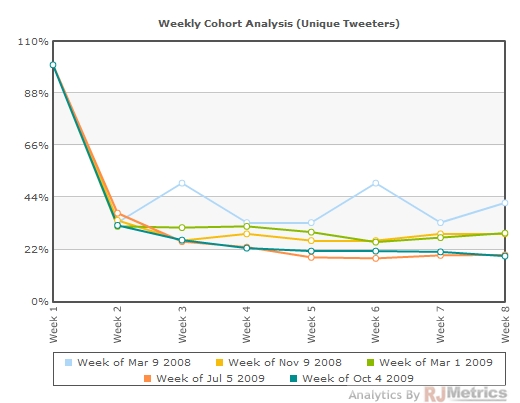
While there is a sizable usage dropoff in week 2, repeat tweeting then holds predictably steady at around 20% of the cohort. This is consistent with the findings in our previous analysis.
To take things a step further, we can define the y-axis of the chart to show the number of tweets sent across everyone in the cohort (rather than just the number of people in the cohort who sent anything). This will help show the total content contribution of the cohort in subsequent time periods. We group cohorts by month in this case:
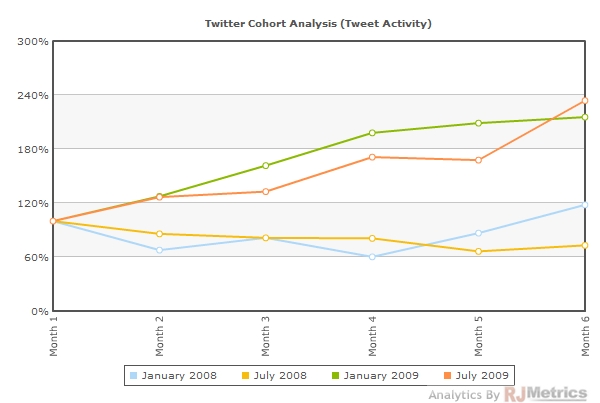
This image alone shows us why Twitter remains a powerhouse despite the high percentage of inactive users.
First, despite the fact that only 20% of tweeters come back to tweet in their second month, those who do come back tweet so much that it makes up for all the people who left.
Second, users who joined more recently (the 2009 cohorts) tweet with far greater frequency in their first few months than their 2008 counterparts. This means that active users are actually becoming more engaged over time.
Conclusion
Analyzing Twitter is like a roller coaster ride:
- When you look at new account registrations, no one can deny that Twitter is still growing like a rocketship(that’s good).
- However, upon closer inspection, the rate of new user signups has dropped meaningfully from its peak and many new users never do anything with their accounts (that’s bad).
- Furthermore, the percentage of accounts sending out tweets has steadily declined over the past six months (that’s worse).
- However, our cohort analysis reveals tremendous loyalty and engagement from those Twitter users who stay on the system after their first week as members (that’s good).
- In fact, those users who stay become more active over time, so much so that they make up for the missing activity from those users who leave (that’s incredibly good).
And, with 75 million total accounts, an active userbase of around 20% still leaves around 15 million highly active tweeters.
The data we pulled from Twitter’s API found a good home inside the RJMetrics dashboard, and your company’s data can too. We would love to share how to capture real value from the data in your backend database using RJMetrics.Try out our online demo to learn more.


Pingback: So hello Vine, Twitter’s new video service. Say, haven’t we met before? | Robin Fenwick - Sporadic commentary on digital, media, politics and music